Google Rewrote Its Ranking Rules With the CMA Watching: What Changed and What to Ask Your SEO Agency
On 24 November 2026, Google quietly published a new Ranking section in its Search Central documentation. Most people will scroll past it. They shouldn't.
Even though I work as a Google Ads consultant nowadays, once upon a time I was an SEO consultant. I spent over a decade making money as a casino affiliate, living almost entirely off Google rankings, so I know how to rank sites. Funnily enough, a manual penalty marked the beginning of the end for me. My site was spam by Google's definition, to be fair, so I just gave up when it got hit. Still, watching a website you spent years building disappear from Google overnight because a manual reviewer pulled the plug does break your spirit.
That is why what Google published on 24 November 2026 is so interesting. For the first time, regulatory pressure is forcing Google to formalise the rules under which it operates.
Three new pages sit at the centre of it: Google's principles for ranking results, how it will give notice of ranking changes, and how site owners can submit feedback and appeals. Two of those pages name the UK Competition and Markets Authority's (CMA) fair ranking conduct requirement directly, and one sets a date for a new UK appeal route.
1. Google now commits to advance notice
Google has formalised when it will warn site owners before a change lands. Two categories trigger notice: actionable policy changes (updates to spam policies, technical guidelines or eligibility criteria where you might need to change your site or markup to stay compliant) and significant ranking changes (broad algorithmic updates, such as core updates, that can move rankings across many queries and sites).
Where UK users may see a significant ranking shift, Google says it gives advance notice in line with the CMA's requirements. Notices, rollout start dates and completion dates go on the Google Search Status Dashboard, which has an RSS feed. If you manage organic search for anyone, subscribe to it today. “We didn't know an update was coming” is no longer a credible excuse.
Google is also explicit about timing. Wait until an update is marked complete, then allow at least another full week of data before you judge the impact. I see agencies rewriting half a site three days into a rollout. That is not strategy, that is tilt.
2. A formal feedback route for ranking updates
When Google announces a significant ranking change or policy update, verified site owners can submit feedback directly in Search Console using the Submit Feedback button. You tag the update with a hashtag, for example #NovemberCoreUpdate2026.
Google asks for specifics:
- A snapshot of your Performance report
- The exact queries, country and language affected
- Your affected URLs alongside competing URLs that seem to rank inappropriately (Google's own example is scraped content outranking the original)
- When and how you were impacted, with before-and-after data
- Why the current results fail searchers
- How the change affected a UK market you operate in
That last bullet is the CMA's fingerprint. Market impact is now a field Google wants to hear about, and it has teeth: if Google receives feedback from 50 different publishers about a material change within 30 business days of its UK rollout completing, it must report the matter to the CMA. The regulator expects to receive copies of the individual submissions.
Set your expectations properly, though. Google states that feedback is reviewed in aggregate to find systemic problems and does not lead to manual ranking adjustments for individual URLs. This is not a back door to page one. It is a way to put evidence on record.
3. New appeal routes, including one for the UK
The feedback page brings every dispute route into one place:
- Manual actions: Fix the issue, then request reconsideration in Search Console.
- Counterfeit goods removals: A dedicated appeal process.
- SafeSearch misclassification: After fixing, wait 2 to 3 months before requesting review, as the classifiers take that long to reprocess.
- DMCA removals: File a counter notice.
- UK CMA indexing appeal: If your site serves UK users and has been manually removed from Google's index as a whole, an appeal route opens on 17 December 2026.
- EU DMA appeal: If you're in the European Economic Area and meet Google's Digital Markets Act (DMA) access conditions but aren't appearing in Search, there is an appeal under Article 6(12). That includes Irish businesses.
For anyone who has ever had a site deindexed and been left shouting into the Search Central forum, this is a real shift. You now have formal routes, not just hope.
4. The principles, in writing
The principles page is short but worth reading in full. Google says it doesn't design its ranking systems or AI models to favour any specific site's interests, never accepts payment to rank pages higher in organic results, and judges every result type (blue links, AI Overviews, carousels, images and video) on how useful it is for the query. It also states it doesn't manually adjust rankings except to meet legal obligations or enforce published content policies, and that helpfulness is measured against the public Search Quality Rater Guidelines.
That last point matters more than it looks. The Rater Guidelines are now explicitly the yardstick. Most SEOs don't even know what they are, never mind have read them. To be fair, I've only read a few editions because most updates are incremental, but if you've never looked at them, read the latest version.
Here's something you can actually just listen to to make sure you understand how Google ranks pages:
Audio study guide: Google's Search Quality Rater Guidelines (Sept 2025 edition, 56 minutes).
5. AI Overviews: controls and source selection
Alongside the ranking section, Google published two new pages on generative AI. The first lays out the controls site owners have, and they're more granular than most people realise:
- Search Console generative AI setting: Your site is included by default. You can choose to exclude your links and content from AI Overviews, AI Mode and AI features in Discover while staying in normal Search. Google says this setting is not used as a ranking signal elsewhere in Search.
- Google-Extended in robots.txt: Limits use of your content for training and grounding in Google's other AI products, like the Gemini app. It doesn't affect your Search rankings.
- nosnippet, data-nosnippet and max-snippet: Page and passage level control over what can be shown or used as a direct input for AI Overviews.
- noindex: Out of Search entirely, AI features included.
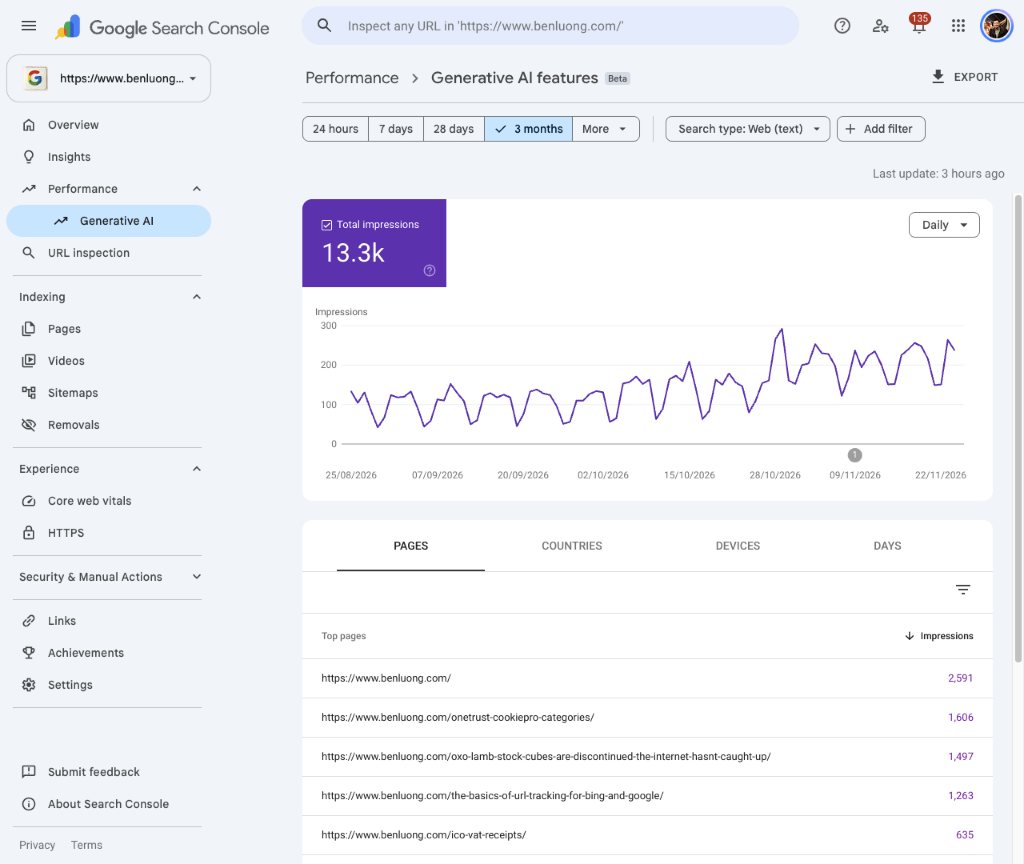
Google also says it intends to support a shared, machine-readable AI training preference signal in early 2027. Don't opt out on instinct. If your business depends on being discovered, being cited in AI Overviews is distribution. Make that call with data from the new Generative AI performance report in Search Console, not with a gut reaction. I'm keeping all my sites in the index.
On source selection, AI Overviews start from Google's ranked web results, run related searches to cover different parts of the question, write the answer, then link to the pages that support it. Google is blunt that what most of the industry is selling as “AEO” or “GEO” is, from its point of view, just SEO. No special markup, no llms.txt and no rewriting content “for AI” is needed. In its words: “No third-party tool has access to our internal ranking or AI systems.” Keep that line handy the next time someone pitches you an AI visibility tool with a proprietary score.
One practical detail I liked: Google advises against changing a page's date unless the content has substantially changed. If your content team bumps dates to look fresh, that habit needs to end.
What to ask your SEO company this week
If you're paying an SEO agency or consultant, this update gives you an easy way to tell whether they're on top of their job or just sending automated monthly PDFs. Send them a quick email and ask:
- Are you subscribed to the Search Status Dashboard feed? With Google now giving advance notice, are you logging pre-update baselines (rankings, Search Console data and SERP screenshots of our competitors) before a rollout starts?
- What's your post-update process? Do you wait until rollout completion plus a full week before making changes, or are you knee-jerk editing pages mid-rollout?
- Are you monitoring who beats us, and how? If a scraper or spammy competitor jumps above us after an update, are you documenting the before-and-after evidence to submit via Search Console's update feedback route?
- Have you checked our Generative AI setting in Search Console? Are we included in AI Overviews and AI Mode, and are you tracking our Generative AI impressions separately? That report only shows impressions, not clicks. Don't let them spin impressions as traffic.
- If we operate in the UK or EEA, are we keeping a clean evidence trail? If an update hits us unfairly or a manual indexing issue lands, do we have dated records ready for Google's feedback form or the new UK CMA and EU DMA appeal routes?
Google is becoming more transparent about how it ranks websites at precisely the moment when ranking is becoming less valuable. You can now receive advance notice of updates, submit evidence, appeal certain decisions and measure your visibility in AI-generated answers. What Google still cannot guarantee is that anyone will actually visit your website.
If you're paying an SEO company, make sure they're measuring traffic, leads and revenue. Impressions don't pay wages.

Ben Luong is a technical marketing consultant who operates where AI falls short. In a world flooded with cheap, mediocre code and automated strategies, he provides the expert integration, verification, and strategic accountability required to make modern marketing stacks profitable. He specialises in architecting Google Ads, SEO, and GA4 into a single, high-performance system that is accountable to the bottom line.
