
OXO Lamb Stock Cubes Are Discontinued. The Internet Hasn’t Caught Up.
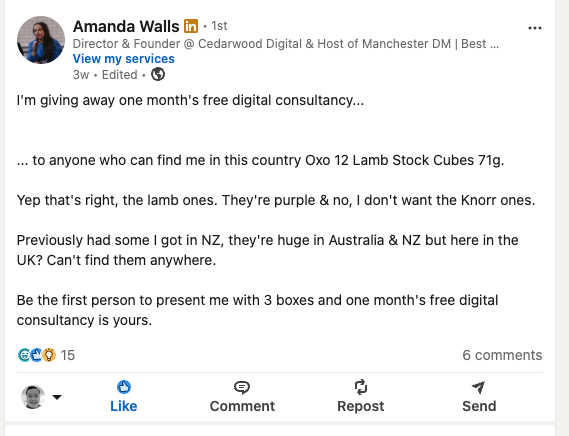
A LinkedIn post from Amanda Walls started this. She was offering a month’s free digital consultancy to anyone who could present her with three boxes of OXO Lamb Stock Cubes. They had to be the purple boxes, with 12 cubes in a 71g pack. Not Knorr, not another flavour, and not a link to something vaguely similar. She had previously bought them in New Zealand but could not find them in the UK.
I thought it sounded like an interesting search challenge. I work in search marketing, use AI extensively, and have access to ChatGPT Pro. Surely, between conventional search and an AI prepared to investigate obscure suppliers across several countries, we could find three boxes of stock cubes.
We did not. What I eventually obtained was direct confirmation that OXO Lamb Stock Cubes had been discontinued in both the UK and New Zealand. Getting to that answer involved dead retailer pages, an Amazon Belgium detour, apparently scraped shopping sites, and cancelling my bank card. It also exposed a problem with AI-assisted search: finding more pages can make an answer look better without bringing you any closer to the truth.
The first mistake was assuming there must be stock somewhere
Initially, there seemed to be plenty of leads. ChatGPT found specialist grocery retailers, overseas sellers, wholesale catalogues and marketplace listings. There were photographs of the correct purple box, product descriptions and prices. Some results looked sufficiently convincing that the next step appeared to be choosing the cheapest delivery option.
One promising inexpensive listing had no buy button. It was a product page, not a purchasing opportunity. Other results were sold out or gave no reliable indication that the seller had any stock. Expensive international listings raised a different question: did these businesses physically hold the product, or would they take an order and then attempt to source it?
The trouble was that every failed lead encouraged another search. I kept asking whether there was anywhere else, and ChatGPT kept finding somewhere else. Looking back, we were accumulating evidence that the product had once been widely listed, while treating it as evidence that somebody must still be selling it.
Amanda had asked for three physical boxes. We were getting rather good at finding photographs of them.
Amazon Belgium looked like a breakthrough
One of the more convincing discoveries was a two-pack listing on Amazon Belgium. It was the exact product on a familiar marketplace, apparently offering an overseas route after the UK searches had failed.
The first obstacle was delivery. The offer I could access would not ship to the required address outside Belgium. That was frustrating, but it initially looked like a logistics problem rather than a stock problem. Perhaps another Amazon storefront carried it, or perhaps the seller could arrange delivery directly.
Then I checked who the seller was. It was the Marvellous Group/London Food Hall operation, which was also behind an eBay listing I was already investigating. The supposed Belgian discovery was not a separate source of supply. It was another marketplace presence belonging to the same business.
The eBay listing was for a “Stock Lovers Bundle”, with a purple OXO Lamb box among its contents. However, London Food Hall’s own website marked the bundle sold out. Its description also allowed unavailable items to be substituted, which was no use for a challenge requiring one very specific product. London Food Hall
I contacted the seller directly. Its reply included the straightforward answer: “Unfortunately we are currently out of stock of the Lamb Stock!”
There was no reason to treat this seller as fraudulent. It answered my question and confirmed the position. The lesson was about the search results: an eBay listing, a retailer website and an Amazon listing in another country had looked like multiple opportunities, but they led back to one business with no lamb cubes available.
Checking the seller’s identity was more useful than searching another country’s Amazon.
The shopping site that led to a cancelled card
A more troubling lead was Eclipse Utility, a website presenting itself as an Irish retailer. It had an enormous assortment of products and an OXO listing with a price and an Add to Basket button. Unlike the cheap catalogue page with no purchasing controls, this appeared to let me place an order.
The details did not inspire confidence. Its category menu mixed household furniture, food, cosmetics and assorted products with inconsistent labels. Some categories referred to shopping in India. Another included the name of a different retailer. This looked less like a carefully maintained shop and more like several catalogues combined without much checking.
The OXO lamb-and-chicken combo page supplied a particularly useful clue. Its title and description matched a listing on the Indian retailer LuckyStore, and the Eclipse image filename still contained “Luckystore”. The LuckyStore listing was marked sold out. Eclipse, meanwhile, had presented the copied-looking product information alongside a functioning basket button. Luckystore.in
To me, this looked like scraped catalogue spam rather than a newly discovered supplier. I could not establish how the content had been obtained or what the operator intended. But there was no verified stock behind the recommendation, and the apparent reuse of another retailer’s material should have made us considerably more cautious.
ChatGPT actually identified several warning signs. It then still suggested that a small order might be worth attempting with protected payment. That was the particularly poor part of the advice: the warnings were acknowledged, but the recommendation did not change enough.
I placed an order, reconsidered, cancelled it and cancelled my card. The card cancellation was a precaution, not proof that my details had been stolen. Nevertheless, that is where the supposedly simple stock-cube hunt had taken me. It would be misleading to leave this episode out and present the investigation as an uncomplicated success for AI.
Searching deeper can mean finding more spam
These questionable sites were in Google too. ChatGPT had not discovered a secret network of suppliers that conventional search could not access. What changed was that, as I pushed it to keep looking, increasingly obscure pages were brought forward as potential answers.
There is a distinction between being indexed, ranking prominently and being trustworthy. Google’s published spam policies cover scraped content and other attempts to manipulate search results, and say that offending sites may rank lower or disappear from results altogether. I cannot establish whether Google had applied a particular penalty to the sites encountered here. Their presence in Google certainly did not amount to an endorsement. Google for Developers
I would therefore not describe this as proof that ChatGPT bypassed Google’s spam filters. I did not test that mechanism. What I observed was simpler: persistent AI-assisted searching surfaced poor-quality shopping pages, and the assistant sometimes gave them more credibility than their contents justified.
The presentation mattered. ChatGPT did not merely show me an obscure result. It summarised the offer, worked out the cost of buying three boxes and suggested what to do next. A questionable listing became a purchasing plan.
This was not always a case of the AI inventing something. The webpage existed. The product photograph existed. The displayed price existed. The unsupported step was moving from those facts to the suggestion that I had found somewhere capable of supplying the product.
A citation can establish that a website advertises something. It cannot, by itself, establish that the seller has it.
The more ordinary retailers failed to produce stock, the more sceptical we should have become about the remaining results. Instead, another obscure listing could still feel like a breakthrough. We were asking the AI to be persistent when what we increasingly needed was for it to challenge the assumption behind the search.
Premier Foods confirmed the UK discontinuation
Eventually, I contacted Premier Foods rather than another retailer. On 3 September 2026, its consumer-relations team replied to my enquiry about OXO Lamb Stock Cubes:
“The majority of our consumers did not appreciate it as much as you and so it was discontinued.”
That was considerably clearer than “currently unavailable”. It explained why the UK retail search was going nowhere, but it did not immediately settle the overseas question. Amanda had bought the product in New Zealand, and there were still New Zealand product pages. Could it have been withdrawn in Britain while continuing elsewhere?
I asked Premier Foods to clarify. It explained that, while it owned the UK OXO brand, the particular New Zealand product was owned by Hutchinsons New Zealand. There was another business to ask, rather than another supermarket website to search.
Hutchinsons confirmed the New Zealand discontinuation
I emailed Hutchinsons, identifying the purple 71g, 12-cube product and asking whether it was still being manufactured. I also asked whether there was any way to purchase three boxes or a trade case for shipment to Britain.
On 7 September 2026, its customer-service team replied: “Unfortunately, the Lamb Oxo Cubes range has been discontinued and is no longer available for sale.”
That closed the New Zealand route as well. We were no longer interpreting empty shelves, missing buy buttons or inconsistent marketplace listings. The businesses responsible for the UK and New Zealand products had both explicitly confirmed discontinuation.
The confusing part was that the public websites did not communicate this as clearly. OXO’s UK FAQ said the lamb cubes were no longer listed with retailers and that it was working with retail partners to get them relisted. That wording left open the prospect of a return, whereas the customer-service response described the product as discontinued. OXO
The New Zealand OXO website also continued to display a dedicated Lamb Stock page with product information and nutritional details. That page helped make the overseas search seem worthwhile, but its continued existence did not mean Hutchinsons was still supplying the product. OXO Foods
This was not simply a matter of ignoring dubious retailers and trusting official websites. Even the official pages needed to be read alongside a direct, dated answer.
Could three boxes still be out there?
Discontinuation does not mean that every box instantly disappears. Somebody may have unopened packets in a cupboard, or a small shop could have overlooked stock. I cannot prove that no three boxes exist anywhere, and the emails do not establish that the product could never be relaunched.
I also explored whether best-before dates could rule out surviving, in-date stock. That was an interesting line of enquiry, but without a confirmed final production date and a manufacturer-verified shelf life, it could not justify a claim that every remaining box must be out of date. It was another hypothesis to investigate, not a substitute for the supplier confirmations.
For somebody deciding whether to keep shopping, however, the distinction is fairly straightforward. Both relevant businesses confirmed discontinuation. Neither reply offered a return date. This was not an ordinary supermarket stock shortage, and I had found no verified source capable of supplying the three boxes.
Any future discovery would need to be judged on the physical stock, not on another surviving product page.
I found the answer, not the stock
I did not fulfil Amanda’s challenge, and I am not claiming a month’s consultancy on a technicality. She asked for three boxes. I obtained two discontinuation confirmations and some unwanted experience of cancelling an order and a card.
What makes the investigation worth documenting is the gap between the apparent abundance of online information and the lack of actual supply. The Amazon Belgium listing looked like a separate overseas opportunity until I checked the seller. The scraped-looking shopping site appeared to offer a purchasing route without demonstrating that it had anything to sell. Even the official product pages did not give the clear answer that arrived by email.
AI helped me investigate, but it also kept the hunt going by presenting weak leads too enthusiastically. The useful question was not how many more results it could find. It was what each result actually proved.
So, for anyone else searching for the purple OXO Lamb Stock Cubes: Premier Foods and Hutchinsons confirmed to me in September 2026 that the UK and New Zealand products had been discontinued. Surviving listings should not be mistaken for continuing supply, and neither company gave me a relaunch date.
I started by trying to find a shop that an SEO expert had missed. I finished by finding the answer that much of the web was failing to provide. The product had been discontinued; the product pages were still doing business.

Ben Luong is a technical marketing consultant who operates where AI falls short. In a world flooded with cheap, mediocre code and automated strategies, he provides the expert integration, verification, and strategic accountability required to make modern marketing stacks profitable. He specialises in architecting Google Ads, SEO, and GA4 into a single, high-performance system that is accountable to the bottom line.

